
The short answer
Wallpaper is a good fit for bedrooms, living and dining rooms, offices, powder rooms with ventilation, and accent walls. We repair and prime the wall, plan the layout so the pattern centers on focal points, hang from a plumb line, match the pattern at every seam and trim cleanly at ceiling and trim. Steady indoor humidity keeps it looking right for years.
Paint covers a wall; wallpaper changes how the room feels. Pattern, texture and scale do things a single color cannot, from making a narrow hallway feel longer to giving a plain bedroom a clear personality. PrimeWall Interior Solutions hangs traditional pasted papers, non-woven papers, prepasted rolls, and designer prints for homeowners in Fort Lauderdale and the Broward neighborhoods around it. You can supply the rolls you have picked out, or we can help you work out quantities before you order. On this page: deciding if wallpaper is right for a particular room, the wall preparation we do, a clear walk through how strips are measured, matched, seamed and trimmed, what makes one job bigger than another, and practical care for the years after.
Is wallpaper a good idea for this room?
Ask how the room is used. Living rooms, dining rooms, bedrooms and offices see little moisture and gentle contact, which suits nearly every type of paper, from delicate prints to textured non-wovens. Powder rooms are a favorite for bold patterns, since the room is small and guests spend just enough time there to notice. Full bathrooms and kitchens can work too, but they call for a washable or vinyl-faced paper and good ventilation.
Next, think about scope. Covering one wall behind a bed or sofa gives impact without overwhelming the space, while papering every wall in a small room can create a cozy, enveloping feel. Ceilings are an option many people forget; a subtle pattern overhead in a dining room or bedroom adds interest without competing with furniture.
Finally, consider light. In bright Fort Lauderdale rooms with large sliders, pale or reflective papers can feel airy, while dark, saturated colors look rich in rooms that get softer light. A sample taped to the wall for a few days, viewed morning and evening, tells you more than any photo.
Wall prep and priming
We remove switch plates, outlet covers and any hardware, then inspect the wall with a light held at a low angle. Holes, cracks and dents are filled and sanded, and textured walls are skim coated when the chosen paper is thin enough to show it. If old wallpaper is present, we usually remove it rather than hang over it, since layered papers tend to bubble.
Then comes primer. A dedicated wallcovering primer creates an even, sealed surface so paste dries at a consistent rate. It lets the installer slide each strip to line up the pattern, and it protects the drywall when the paper is eventually removed. For papers with a light background, we may tint the primer so seams do not show a white line. On exterior walls of block homes, which can run damp in summer, we check moisture before priming.
Measuring, matching, seaming and trimming
Every job starts with measurements: wall widths, ceiling height, and the size and location of windows and doors. We read the roll label for width, length, pattern repeat and match type. A straight match lines up horizontally across strips, a drop match shifts by half the repeat on every other strip, and a random match needs no alignment. Those details decide how many strips each roll yields and how much waste to expect.
Layout follows. We decide where the first strip goes so the pattern centers on the fireplace, the bed or the main wall, and where the last strip will meet the first, usually in a low-visibility corner behind a door. A laser level gives a true vertical line, because walls and corners are rarely plumb.
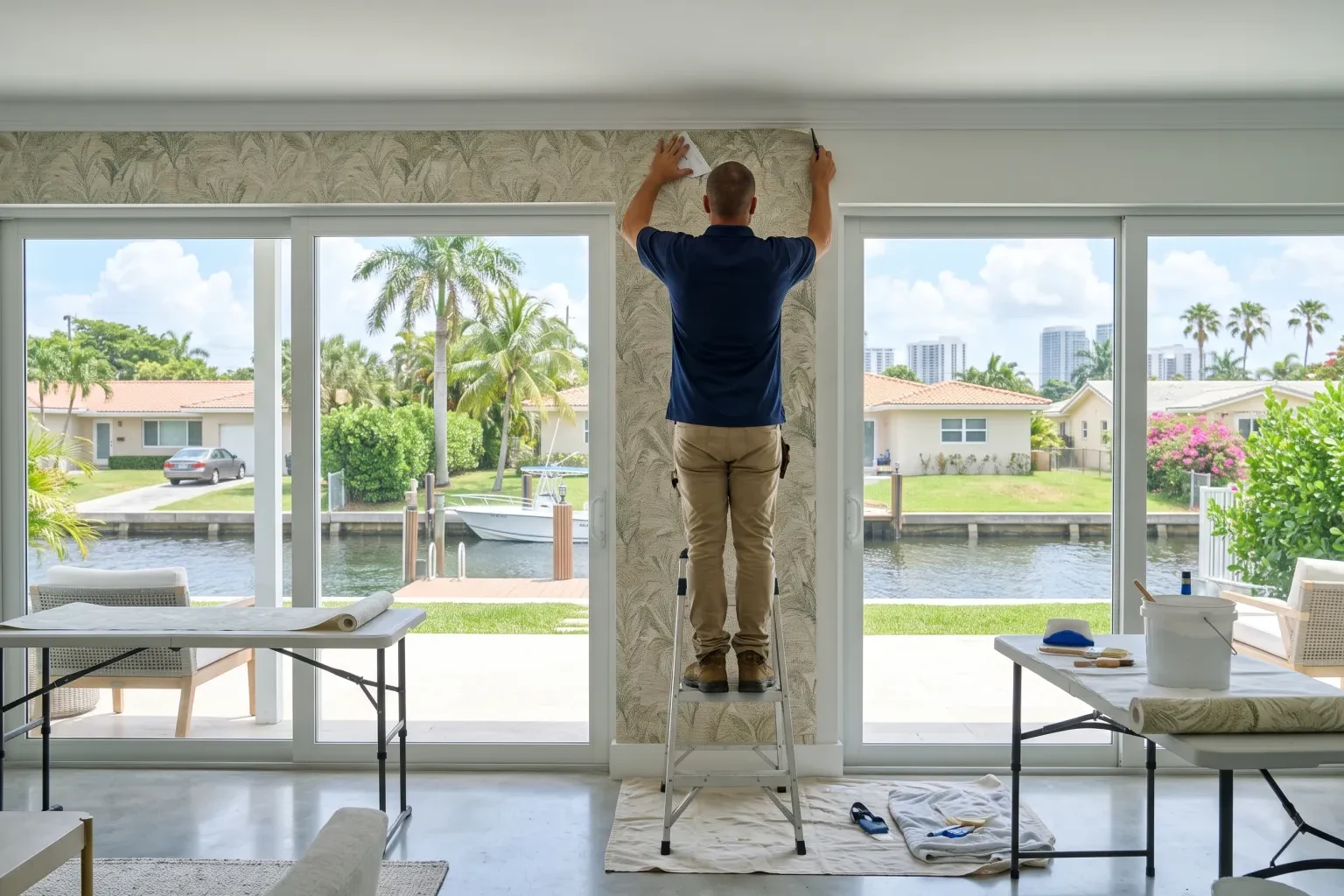
Each strip is cut with extra length at top and bottom, pasted or activated as the maker directs, and booked to relax. We hang it to the line, slide it to match the pattern with the strip beside it, and smooth from the center outward to remove air. Seams are butted tightly and rolled lightly; on certain papers we double-cut through an overlap for a perfect join. Paste on the face is wiped off with clean water right away.
Trimming is the last detail and the one that shows. We cut at the ceiling line, the baseboard, door casings and window trim using a sharp blade changed often, guided by a broad knife. Outlets and switches are cut out after hanging, and cover plates go back on to finish the room.
- Measure the room and read the roll's repeat and match type
- Plan where the pattern centers and where the final seam falls
- Hang the first strip to a laser plumb line
- Match the pattern and butt or double-cut every seam
- Trim at ceiling, baseboard and casings, then reset plates
What affects the size of the project
Wall condition comes first: a smooth, sound wall needs only primer, while a wall with old paper, texture or cracks needs work before hanging. The paper type matters next. Prepasted and non-woven papers move quickly, while hand-printed or delicate designer papers require slower handling and sometimes edge trimming. A large pattern repeat or a drop match uses more paper per strip and adds layout time.
Room size and ceiling height affect the number of strips and the equipment needed. A tall entry, a stairwell or a room with vaulted ceilings takes longer than a standard bedroom. Rooms with many windows, doors, arches, built-ins or a fireplace surround add cutting around obstacles, which takes more time than running full strips across an open wall.
Caring for wallpapered walls
Check the roll label for the cleaning rating. Washable papers handle a soft, damp sponge; scrubbable papers take a gentle brush; non-washable papers should only be dusted. Always test in a hidden spot first, and avoid harsh chemicals.
Humidity is the factor to watch in South Florida. Keep the AC running at a steady setting, including when you travel during the hot, wet months, and run exhaust fans in baths. If you lose power in a storm and the house heats up for days, seams may lift slightly; most settle again once conditions return to normal, and a lifted edge can be pressed back with a little seam adhesive.
Wallpaper Installation by city
- Wallpaper Installation in Lauderdale-by-the-SeaLocal service & repairs
- Wallpaper Installation in Oakland ParkLocal service & repairs
- Wallpaper Installation in Wilton ManorsLocal service & repairs
- Wallpaper Installation in Pompano BeachLocal service & repairs
- Wallpaper Installation in Lauderdale LakesLocal service & repairs
- Wallpaper Installation in Lighthouse PointLocal service & repairs
- Wallpaper Installation in North LauderdaleLocal service & repairs
- Wallpaper Installation in Hillsboro BeachLocal service & repairs
- Wallpaper Installation in LauderhillLocal service & repairs
- Wallpaper Installation in MargateLocal service & repairs
- Wallpaper Installation in Coconut CreekLocal service & repairs
- Wallpaper Installation in Deerfield BeachLocal service & repairs