
The short answer
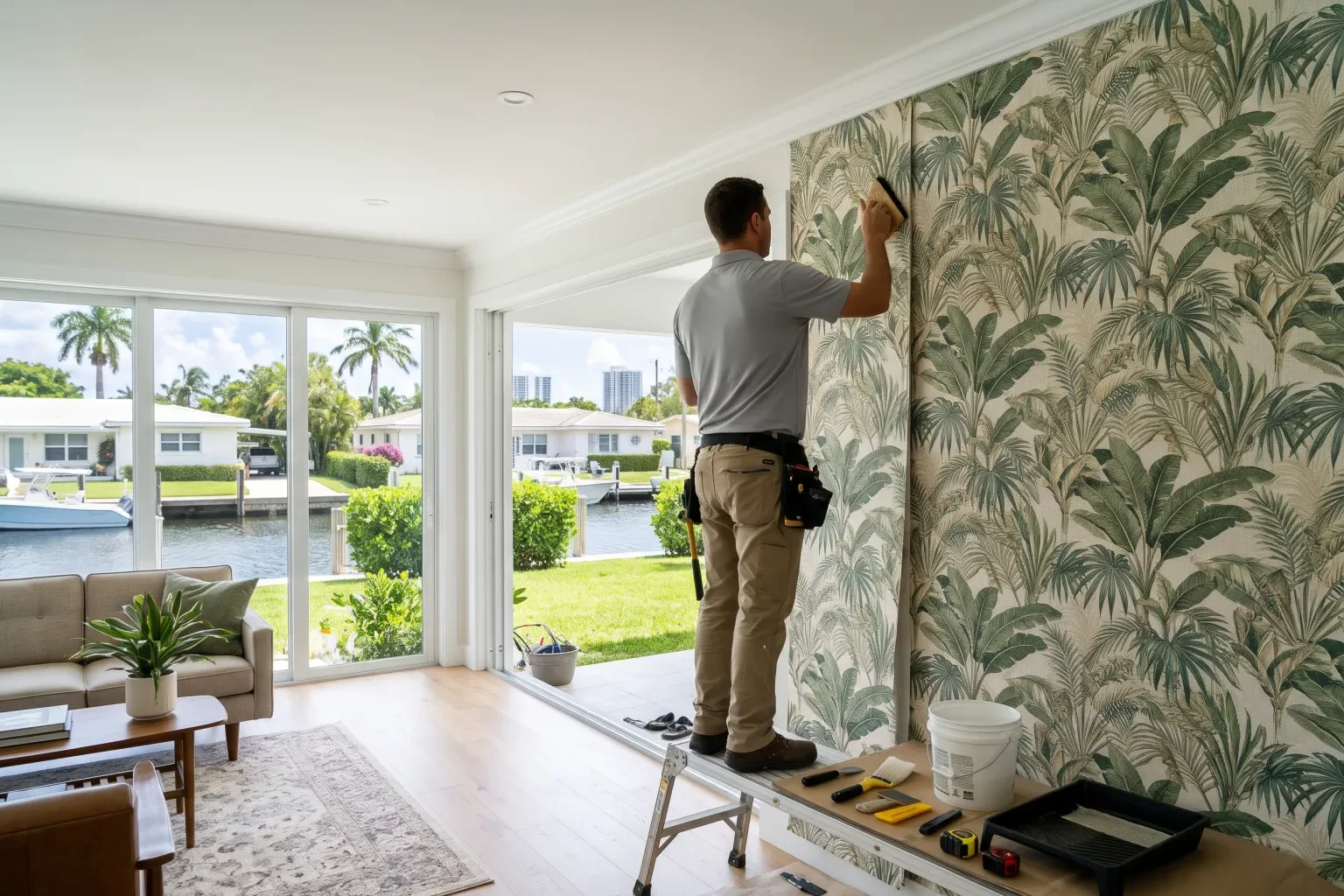
An accent wall is a smart choice when you want pattern or texture without papering a whole room. We repair and prime the wall, center the design on its focal point, hang with tight seams, and trim cleanly at ceilings, corners and baseboards.
One papered wall can change how an entire room feels. Behind a bed, it becomes a headboard you never have to dust. In a dining room, it gives the table a backdrop. In a narrow hallway, a bold vertical stripe can make the ceiling feel higher. PrimeWall Interior Solutions installs accent walls for Fort Lauderdale homeowners and nearby Broward neighborhoods, and because the job is small in square footage, every detail shows: the centering of the motif, the straightness of the first drop, and the crispness of the cut where paper meets painted wall. This page explains how we approach that single wall from first look to final trim.
Is one feature wall the right move for your room?
Accent walls work best where the eye already lands. Think of the wall facing you as you enter, the one behind a sofa or headboard, the back of a built-in bookcase, or a powder room vanity wall. Choosing a single surface keeps strong patterns from overwhelming a space and lets you try a dramatic print without committing every wall to it.
They also suit the open floor plans common in newer Broward homes, where a great room flows into the kitchen with few natural breaks. Papering one wall can define a reading nook or dining zone inside that open space. In older ranch homes with lower ceilings, a lighter paper with a vertical emphasis can lift the room visually rather than closing it in.
There are times we suggest something else. If the wall has several windows and doors cutting through it, the pattern gets chopped into small pieces and the effect is lost. A wall that takes direct afternoon sun through west-facing glass may fade certain inks faster, so we steer toward fade-resistant products there.
- Good candidates: headboard walls, entry walls, dining backdrops, powder rooms
- Use caution: walls broken up by many openings or exposed to harsh sun
- Consider scale: large motifs need a wide, uninterrupted surface
Preparing and priming that single surface
Because neighboring walls stay painted, the accent wall needs to sit flush and clean against them. We start by removing outlet covers, switch plates and any wall-mounted hardware. Then we inspect the surface with a raking light to spot dents, ridges and old anchor holes that would telegraph through thinner papers.
Holes and cracks get filled and sanded smooth. Glossy or semi-gloss paint is dulled so primer can bond. If the wall is concrete block with plaster on it, as is typical in many South Florida homes, we check that the plaster is sound and not hollow or crumbling. Then we roll on a wallcovering primer designed for the paper type, which seals the surface, gives the adhesive something even to grab, and makes the paper far easier to remove later.
Humidity matters here. We ask that the air conditioning stay on during and after the work, because our muggy summer air slows drying and can cause seams to open as the paper shrinks back.
Step by step: measuring, matching, seaming and trimming
First we measure the wall width and height and note the pattern repeat printed on the roll label. That tells us how many strips we need and how much waste each drop creates. Rolls are checked for matching batch or dye lot numbers so color stays consistent edge to edge.
Next comes layout. On an accent wall, the pattern should be centered on the focal point, whether that is the middle of a bed, a fireplace or the wall itself. We mark the center and work out whether a strip or a seam should sit there, then snap a plumb line rather than trusting corners, which are rarely perfectly vertical.
Each strip is pasted, or activated for prepasted papers, and booked so the adhesive relaxes evenly. We hang the first drop on the plumb line, smooth out air with a soft brush or plastic smoother, and line up each following strip so the motif continues without a jog. Seams are butted tight rather than overlapped, and a seam roller is used lightly so edges stay flat without crushing texture.
Finally, trimming. Excess at the ceiling and baseboard is cut with a sharp blade against a broad knife, changing blades often so the edge never tears. At the two side corners, we wrap just slightly or cut directly into the corner so the transition to paint looks deliberate. Outlet and switch openings are cut and the covers reinstalled.
What shapes the cost of an accent wall
We do not post pricing here because every wall is different, but these are the factors that move a quote up or down.
- Wall condition: smooth painted drywall needs far less work than patched plaster or a wall with old paper still on it
- Paper type: peel and stick, standard pasted rolls, grasscloth and hand-printed papers each handle differently and take more or less time
- Pattern repeat: a large drop match wastes more paper and slows each strip
- Wall size and ceiling height: tall walls in two-story entries may need scaffolding or planks
- Obstacles: windows, doors, built-ins and many outlets add careful cutting
Living with and cleaning your new accent wall
Give the paper a few days to cure fully before hanging art or leaning furniture against it, and keep the AC running steadily during that time. Afterward, most papers labeled washable can be wiped with a damp, soft cloth and a mild soap, working gently from the bottom up. Grasscloth and other natural fibers should only be dusted or vacuumed with a brush attachment, since water can stain them.
If a seam ever starts to lift, a small amount of seam adhesive pressed in with a roller usually fixes it before it spreads. Keep a leftover piece of paper stored flat in a closet, not a hot garage, in case a section ever needs patching.
Accent Wall Installation by city
- Accent Wall Installation in Lauderdale-by-the-SeaLocal service & repairs
- Accent Wall Installation in Oakland ParkLocal service & repairs
- Accent Wall Installation in Wilton ManorsLocal service & repairs
- Accent Wall Installation in Pompano BeachLocal service & repairs
- Accent Wall Installation in Lauderdale LakesLocal service & repairs
- Accent Wall Installation in Lighthouse PointLocal service & repairs
- Accent Wall Installation in North LauderdaleLocal service & repairs
- Accent Wall Installation in Hillsboro BeachLocal service & repairs
- Accent Wall Installation in LauderhillLocal service & repairs
- Accent Wall Installation in MargateLocal service & repairs
- Accent Wall Installation in Coconut CreekLocal service & repairs
- Accent Wall Installation in Deerfield BeachLocal service & repairs